AI Executive Assistant: designing for quick answer, not a dashboard user has to dig through. 🖌️
A data-heavy analytics dashboard was slowing C-suite down. Finding one KPI meant clicking through filters and charts just to answer a single business question. I designed a conversational AI assistant that let executives ask in plain language and get a trustworthy answer in seconds, for a leading CPG company.
Problem framing → competitor analysis → conversational flow design → trust framework → high-fidelity UI → prototyping → stakeholder alignment
Outcome: an assistant built to earn trust, one answer at a time.
- Led the UX process through discovery to high-fidelity design
- Ran competitive analysis of existing executive analytics tools
- Designed conversation flows for L1 & L2 high-fidelity questions
- Delivered inside the client's existing design system
- Competitor analysis of AI analytics assistants
- Conversation flow maps and suggested-question logic
- Error and permission-denied state library
- Interactive prototype for stakeholder review
The problem was not missing insight. It was missing speed.
The dashboard held the answer to almost every question an executive might ask. Getting to it was the part that was broken.
- Data-heavy → a dense dashboard packed with charts, tables and filters
- Hard to navigate → finding one KPI meant clicking through several menus and filter combinations
- Search that did not help → the dashboard's built-in search rarely got an executive to the right answer
- Time-poor users → C-suite executives could not spend minutes solving what should be a one-line answer
- No shortcut → there was no faster path from having a question to having an answer
Research told me what to build. Trust told me how.
Quick interviews with executives were enough to confirm the ask. The harder design problem sat underneath: how do you get someone to actually rely on an AI answer.
THE ASK WAS CLEAR
Interviews were short because executives already knew what they wanted. The open question was never scope, it was whether they would trust what came back.
NOBODY KNEW WHAT TO ASK
Several executives were not sure what even the assistant could answer, which meant an empty chat box was a barrier all on its own.
AI MEANS FAST, OR IT MEANS NOTHING
If the assistant hesitated or got something wrong even once, the expectation was that people would simply go back to the dashboard for good.
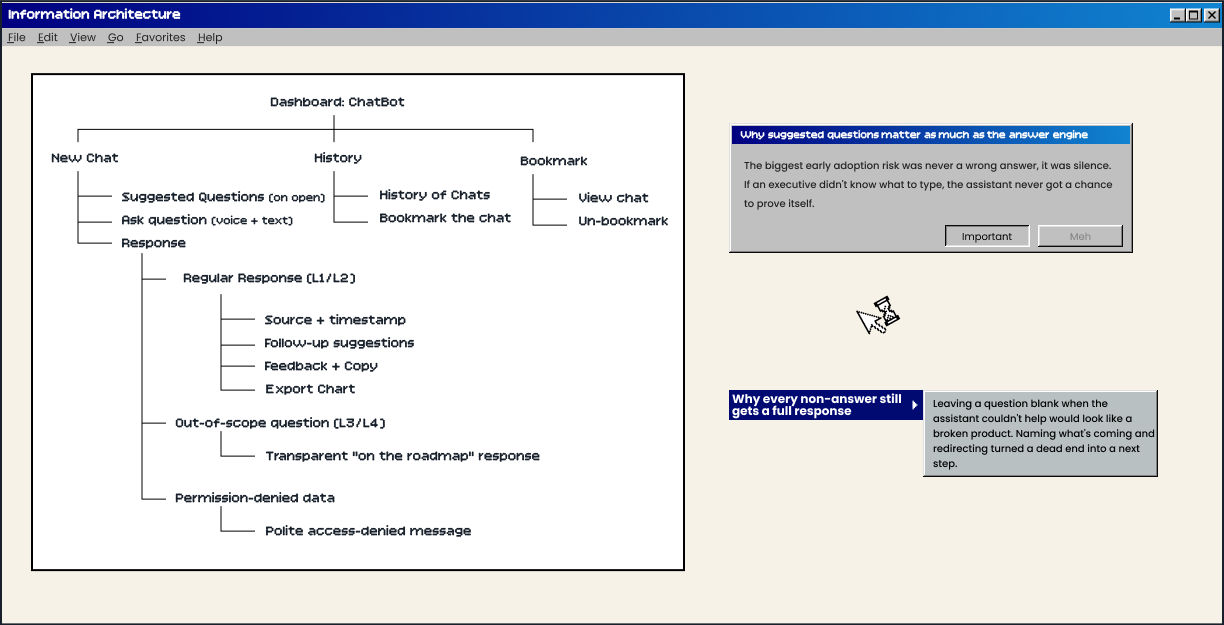
The core experience: from a blank chat to a trusted answer.
Every part of the flow exists to solve one problem, get an executive from "I have a question" to "I have my answer," without a single wasted step.
The final interface makes trust visible, not implied.
The biggest design shift wasn't visual. It was deciding what the assistant should say when it couldn't answer at all.
- Early idea: don't respond to anything outside L1 and L2 scope
- Kept the experience clean and avoided drawing attention to limits
- But a missing answer reads as a broken assistant, not a scoped one
- Every out-of-scope question gets an honest reply naming what's on the roadmap
- Every permission-denied answer explains why, and who to ask
- Both states redirect to a question the assistant can actually help with
Every answer arrives with a source. Every gap gets a straight, human response instead of silence.
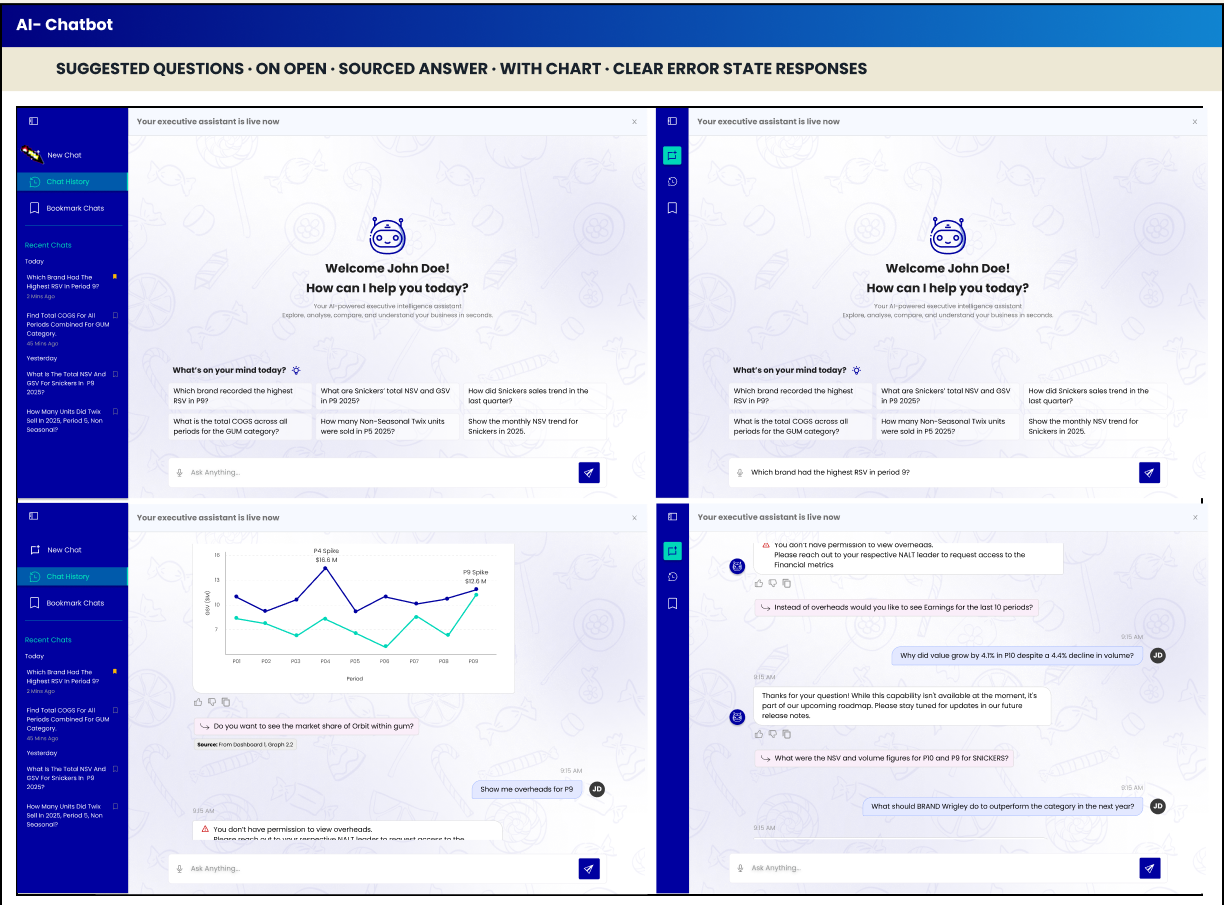
What I delivered.
A complete, design-system-aligned experience, from the first suggested question to the last edge case, inside one month.
DESIGN FOR TRUST, NOT JUST TASKS
A correct answer that nobody believes is still a failed product. Sourcing and transparency were treated as core features, not nice to haves.
MEET PEOPLE WHERE THEY DON'T KNOW WHAT TO ASK
Suggested questions did more for adoption than the answer engine itself, because they solved the moment before the question even happens.
TURN A GAP INTO A REDIRECT
When the product can't help, saying so honestly and pointing somewhere useful beats the illusion of solving it, instead of losing the relationship.
The goal was never to build a chatbot that could answer everything. It was to build one an executive would actually come back to.